# Registration
> You must **first register** for Track 03 - Sleep Onset before you can participate. **Registration takes three steps.** Open **Get Started → Registration Guide** in the menu on the left. Follow the approval instructions and, if applicable, the additional setup required for teams.
---
# Before building a submission
> To be evaluated successfully and appear on the leaderboard, every uploaded model must follow the **strict Codabench submission contract**. Before preparing and uploading your model, open **Get Started → Submission Guide** in the menu on the left. It defines the Python inference contract, output shape, trained weights, optional files, and validation workflow. The same guide and its executable examples are public in the **[2026 competition repository](https://github.com/neural-interfaces26/2026-competition)**.
---
# After uploading: when will my score appear?
> **Your submission may remain queued before evaluation starts.** All four tracks share the same evaluation queue, so your score may not appear immediately. You can leave the page and return later; refreshing the Codabench webpage will not accelerate the evaluation process.
---
# Track 03 · Sleep Onset
> **Sealed-phase specification.** The description, task contract, and ranking metric below define the final Muse phase. Warm-up uses the public Muse data and scores W-bMAE per recording, without the sealed phase's seen/unseen split. Phase-specific differences are detailed below.
For focused answers about the public release, first-N2 target, preprocessing, stream boundaries, model state, inference metadata, and scoring, read the **[Track 03 Scientific FAQ](https://github.com/neural-interfaces26/2026-competition/blob/main/codabench/pages/scientific_faq_sleep.md)**.
_Estimate how long remains before the first N2 sleep epoch from wearable EEG recorded at home._
Given a continuous **four-channel, 128 Hz home EEG** recording, predict from each five-second window the number of seconds remaining until the first N2 epoch, capped at 600 seconds. Windows arrive one at a time in chronological order. Models may use past context within the current recording, but never future windows, and their state is reset between recordings. Evaluation includes both new recordings from participants represented in training and recordings from completely unseen participants.
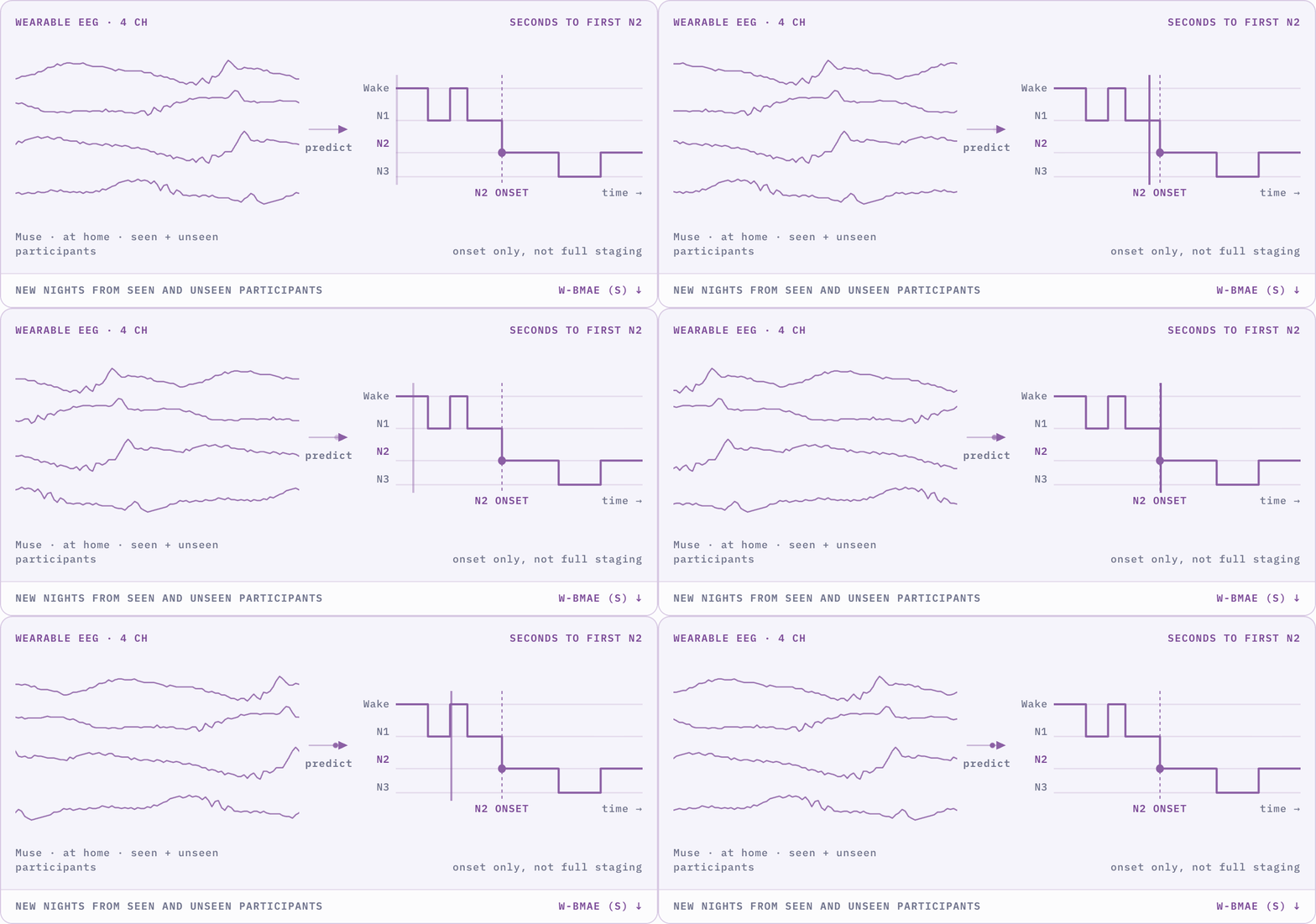
## Sealed-phase task contract
| | |
| ------------------------ | ------------------------------------------------------------------------- |
| **Input** | Chronological five-second windows from four-channel Muse EEG at 128 Hz |
| **Prediction** | One latency in seconds until the first N2 epoch per window, capped at 600 seconds |
| **Objective** | Estimate approaching first N2 from the current and earlier windows only |
| **Generalization shift** | New nights from seen participants and recordings from unseen participants |
| **Sealed split** | Separate seen-subject and unseen-subject evaluation groups |
## Sealed-phase ranking metric
> **Weighted binned mean absolute error, or W-bMAE, in seconds. Lower is better.**
Codabench computes mean absolute error separately within four true time-to-onset ranges: **[0, 40)**, **[40, 90)**, **[90, 300)**, and **[300, 600]** seconds. These ranges receive severity weights of **10×, 5×, 3×, and 1×**, respectively, so errors closer to sleep onset contribute more strongly.
W-bMAE is reported separately for **seen subjects** (new recordings from people represented in training) and **unseen subjects** (people absent from training). The final ranking metric is the macro-average of these two scores, giving equal importance to night-to-night and inter-person generalization.
## Development, warm-up, and sealed data
**Development and training.** You may train your model on any of the organizer-recommended public datasets in the **[main website’s dataset directory](https://neural-interfaces26.github.io/tracks.html#datasets)** or other data permitted by the Terms. The public **[Track 03 competition directory](https://github.com/neural-interfaces26/2026-competition/tree/main/tracks/sleep_onset)** contains the executable contract and metric, dataset adapters, editable worked solvers, Benchopt configs, and NeuralBench checkpoint wrapper.
**Warm-up evaluation.** Warm-up submissions on Codabench are evaluated on the 40 test recordings of the public **Muse** training data ([NEMAR nm000287](https://doi.org/10.82901/nemar.nm000287)), from its supplied session split: every test participant also appears in its 500 training recordings. This evaluation set matches the test set in the [Track 03 NeuralBench start kit](https://facebookresearch.github.io/neuroai/neuralbench/auto_examples/biosignal_challenge_2026/plot_track3_sleep_onset.html). Codabench streams each recording from its start, one window at a time, computes W-bMAE within each recording over its non-empty ranges, and averages it over recordings. Unweighted bMAE and plain MAE over all windows are reported separately. The seen/unseen macro-average applies to the sealed evaluation only.
The Muse data is the default dataset of the **[Track 03 NeuralBench start kit](https://facebookresearch.github.io/neuroai/neuralbench/auto_examples/biosignal_challenge_2026/plot_track3_sleep_onset.html)**, whose `test/wbmae_stream_mean` is the warm-up score. The **[reported public baseline scores](https://neural-interfaces26.github.io/participant-guide.html#baseline-track-3)** use the public **Muse** split. Because the test data and labels are public, training overlap, overfitting, or leakage is possible. Warm-up scores are indicative only and support submission validation and iteration. Only the sealed phase determines the final ranking.
> **NeuralBench version.** The current Track 03 start kit requires NeuralBench 0.4.0. Install or upgrade it in the same Python environment with `python -m pip install --upgrade "neuralbench==0.4.0"`; older versions report `_sleep_onset_stream` as an invalid task.
**Legacy warm-up.** Codabench previously used two-channel Sleep-EDF with batched windows and unweighted bMAE. The current Muse warm-up uses four channels at native 128 Hz, chronological one-window-per-recording streaming, and per-recording W-bMAE, so prior submissions must be adapted and scores are not comparable.
**Sealed evaluation.** Codabench uses the private 2026 Muse cohort described in the **[main website’s dataset directory](https://neural-interfaces26.github.io/tracks.html#dataset-track-3)**. It combines new recordings from participants represented in training with recordings from completely unseen participants. Recordings, labels, group membership, and exact cohort composition remain hidden.
## Track resources and next steps
**[Explore the full Track 03 description on the main website →](https://neural-interfaces26.github.io/tracks.html#track-3)** · **[Choose a repository workflow →](https://github.com/neural-interfaces26/2026-competition/blob/main/tracks/README.md)** · **[Use the NeuralBench start kit and public baselines →](https://facebookresearch.github.io/neuroai/neuralbench/auto_examples/biosignal_challenge_2026/plot_track3_sleep_onset.html)** · **[Review prizes and conditions →](https://neural-interfaces26.github.io/prizes.html#award-track-3)**
For packaging and uploads, use **Get Started → Submission Guide**. For current dates and submission limits, use **Phases**. For eligibility, data use, and the reproducibility audit, use **Terms**.
---
## Track partners
### Sponsor and scientific institution
 **Muse** sponsors Track 03, leads its scientific development, and provides its labeled training and hidden evaluation cohorts.
### Organizing institutions