# Registration
> You must **first register** for Track 04 - EMG-to-Pose before you can participate. **Registration takes three steps.** Open **Get Started → Registration Guide** in the menu on the left. Follow the approval instructions and, if applicable, the additional setup required for teams.
---
# Before building a submission
> To be evaluated successfully and appear on the leaderboard, every uploaded model must follow the **strict Codabench submission contract**. Before preparing and uploading your model, open **Get Started → Submission Guide** in the menu on the left. It defines the Python inference contract, output shape and unit, trained weights, optional files, and validation workflow. The same guide and its executable examples are public in the **[2026 competition repository](https://github.com/neural-interfaces26/2026-competition)**.
---
# After uploading: when will my score appear?
> **Your submission may remain queued before evaluation starts.** All four tracks share the same evaluation queue, so your score may not appear immediately. Once started, Track 04 currently needs around 2–3 minutes to load and score the evaluation data, plus the model's inference time. You can leave the page and return later; refreshing the Codabench webpage will not accelerate the evaluation process.
---
# Track 04 · EMG-to-Pose
> **Sealed-phase specification.** The description, task contract, and ranking metric below define the final sealed phase. Warm-up uses the same prediction and metric contract on public EMG2Pose data. Phase-specific data are detailed below.
For focused answers about the sealed cohort, preprocessing, external data, batching, model state, and radian-to-degree scoring, read the **[Track 04 Scientific FAQ](https://github.com/neural-interfaces26/2026-competition/blob/main/codabench/pages/scientific_faq_emg.md)**.
_Predict continuous hand motion from electrical activity recorded at the wrist._
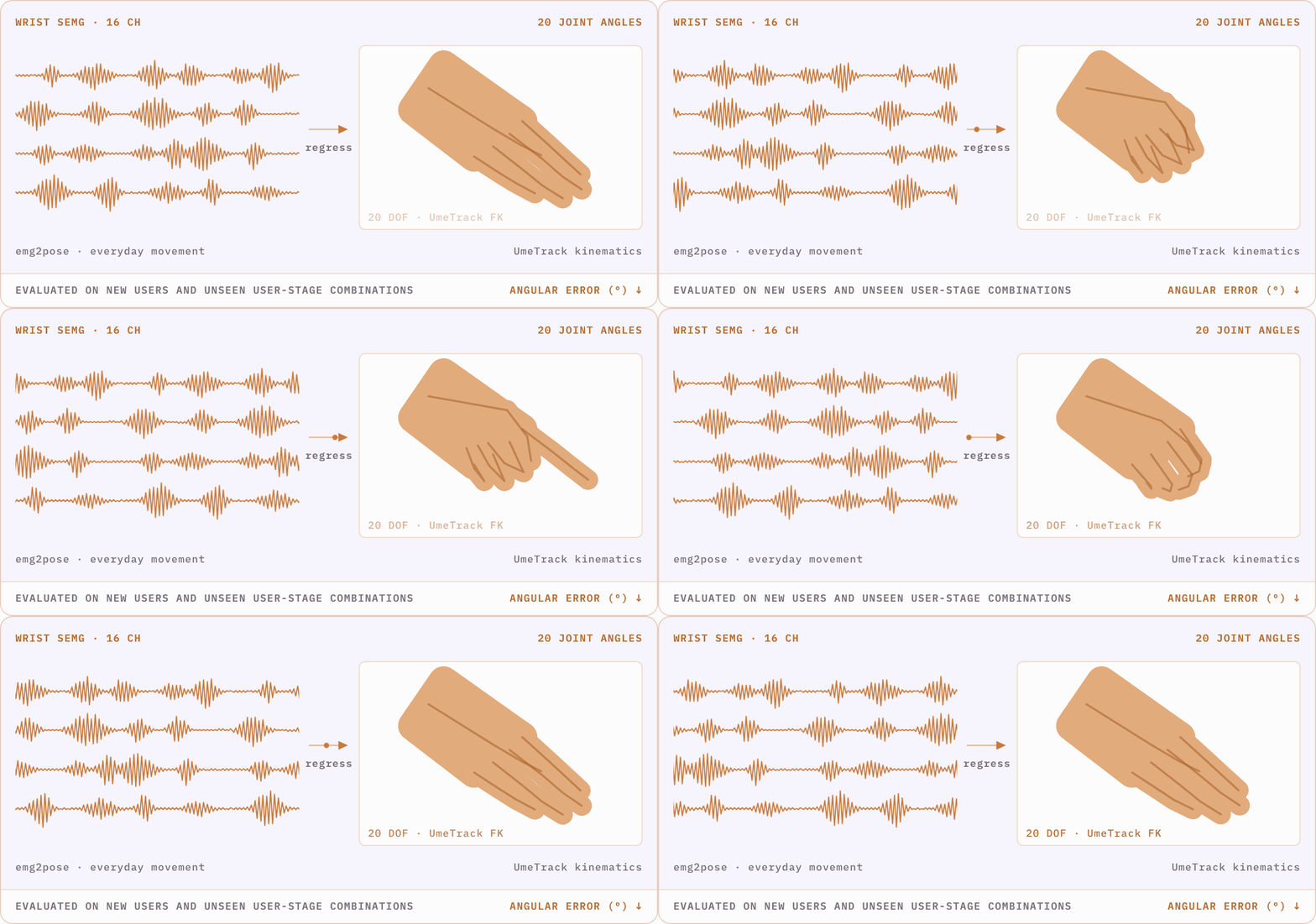
Given a window of **16-channel wrist surface EMG**, predict continuous trajectories for **20 UmeTrack hand-joint angles**. **Models must return radians; Codabench converts the resulting MAE to degrees for the leaderboard.** The sealed evaluation covers users and movement stages absent from training, plus unseen combinations of users and stages. This tests transfer across anatomy, wristband placement, and movement context.
## Sealed-phase task contract
| | |
| ------------------------ | ------------------------------------------------------------------ |
| **Input** | One temporal window of 16-channel wrist sEMG |
| **Prediction** | Continuous trajectories for 20 UmeTrack joint angles in radians |
| **Objective** | Reconstruct hand pose throughout the input window |
| **Delivery** | Independent five-second windows in ordinary evaluation batches |
| **Generalization shift** | New users, new movement stages, and unseen user-stage combinations |
| **Sealed split** | Evaluation examples and labels remain hidden |
## Sealed-phase ranking metric
> **Mean absolute angular error in degrees. Lower is better.**
Codabench computes the absolute angular difference in radians between every predicted and reference value, averages over all evaluation examples, joints, and time points, then converts the result to degrees for the leaderboard. If a model predicts on a coarser time axis, its output is nearest-neighbor resampled to the target length before scoring.
## Development, warm-up, and sealed data
**Development and training.** You may train your model on any of the organizer-recommended public datasets in the **[main website’s dataset directory](https://neural-interfaces26.github.io/tracks.html#datasets)** or other data permitted by the Terms. The public **[Track 04 competition directory](https://github.com/neural-interfaces26/2026-competition/tree/main/tracks/emg_pose)** contains the executable contract and metric, dataset adapters, editable worked solvers, Benchopt configs, and NeuralBench checkpoint wrapper.
**Warm-up evaluation.** Warm-up submissions on Codabench are currently being evaluated on a subset of the public **EMG2Pose** dataset. This evaluation subset matches the test set in the [Track 04 NeuralBench start kit](https://facebookresearch.github.io/neuroai/neuralbench/auto_examples/biosignal_challenge_2026/plot_track4_emg_to_pose.html): rows marked `generalization = user_stage` form the Codabench evaluation partition and contain unseen combinations of users and movement stages represented elsewhere in the public data. Warm-up evaluates independent windows in ordinary batches. It uses the same mean absolute angular error as the sealed phase, averaged across all examples, joints, and time points. Models predict radians; Codabench multiplies the resulting MAE by `57.29578` to report degrees, matching the conversion from NeuralBench's `test/mae`.
EMG2Pose also underlies the **[reported NeuroPose baseline scores](https://neural-interfaces26.github.io/participant-guide.html#baseline-track-4)**. Because the data and labels are public, leakage is possible and warm-up scores are indicative only. Only the sealed phase determines the final ranking.
**Sealed evaluation.** Codabench switches to the private 2026 Meta Reality Labs cohort described in the **[main website’s dataset directory](https://neural-interfaces26.github.io/tracks.html#dataset-track-4)**. It includes movement stages outside the 29 public EMG2Pose stages. As in warm-up, five-second windows are evaluated as independent examples in ordinary batches. Batch size, composition, and order are not part of the contract, so submissions must not rely on temporal continuity or persistent state across `predict` calls. Label-free adaptation inside the current batch, including gradient updates, is allowed within the worker time and memory limits. The cohort is uploaded only for the sealed phase, and its evaluation examples and labels remain hidden.
## Track resources and next steps
**[Explore the full Track 04 description on the main website →](https://neural-interfaces26.github.io/tracks.html#track-4)** · **[Choose a repository workflow →](https://github.com/neural-interfaces26/2026-competition/blob/main/tracks/README.md)** · **[Use the NeuralBench start kit and public baseline →](https://facebookresearch.github.io/neuroai/neuralbench/auto_examples/biosignal_challenge_2026/plot_track4_emg_to_pose.html)** · **[Review prizes and conditions →](https://neural-interfaces26.github.io/prizes.html#award-track-4)**
For packaging and uploads, use **Get Started → Submission Guide**. For current dates and submission limits, use **Phases**. For eligibility, data use, and the reproducibility audit, use **Terms**.
---
## Track partners
### Sponsor and scientific institutions

 **Meta Reality Labs** sponsors Track 04, co-leads its scientific development, and provides its 2026 hidden evaluation cohort. **Imperial College London** contributes to the scientific development and organization.
### Organizing institutions